
From Rural Roads to Sea-Crossing Bridges: How to Choose the Right Asphalt Mixing Plant
September 21,2026
Buying an asphalt mixing plant is a big decision. The most expensive mistake isn't paying too much — it's buying a plant that doesn't match your project.
We've seen it happen. A 320 t/h stationary batch plant sits idle for nine months after a three-month county road contract ends. Or an older drum plant with loose batching control produces a mix that gets rejected at the gate of a bridge deck project. Both scenarios cost contractors far more than the initial purchase price.
The right approach? Start with your project type, then talk about capacity and configuration.
Two Main Types of Asphalt Mixing Plants
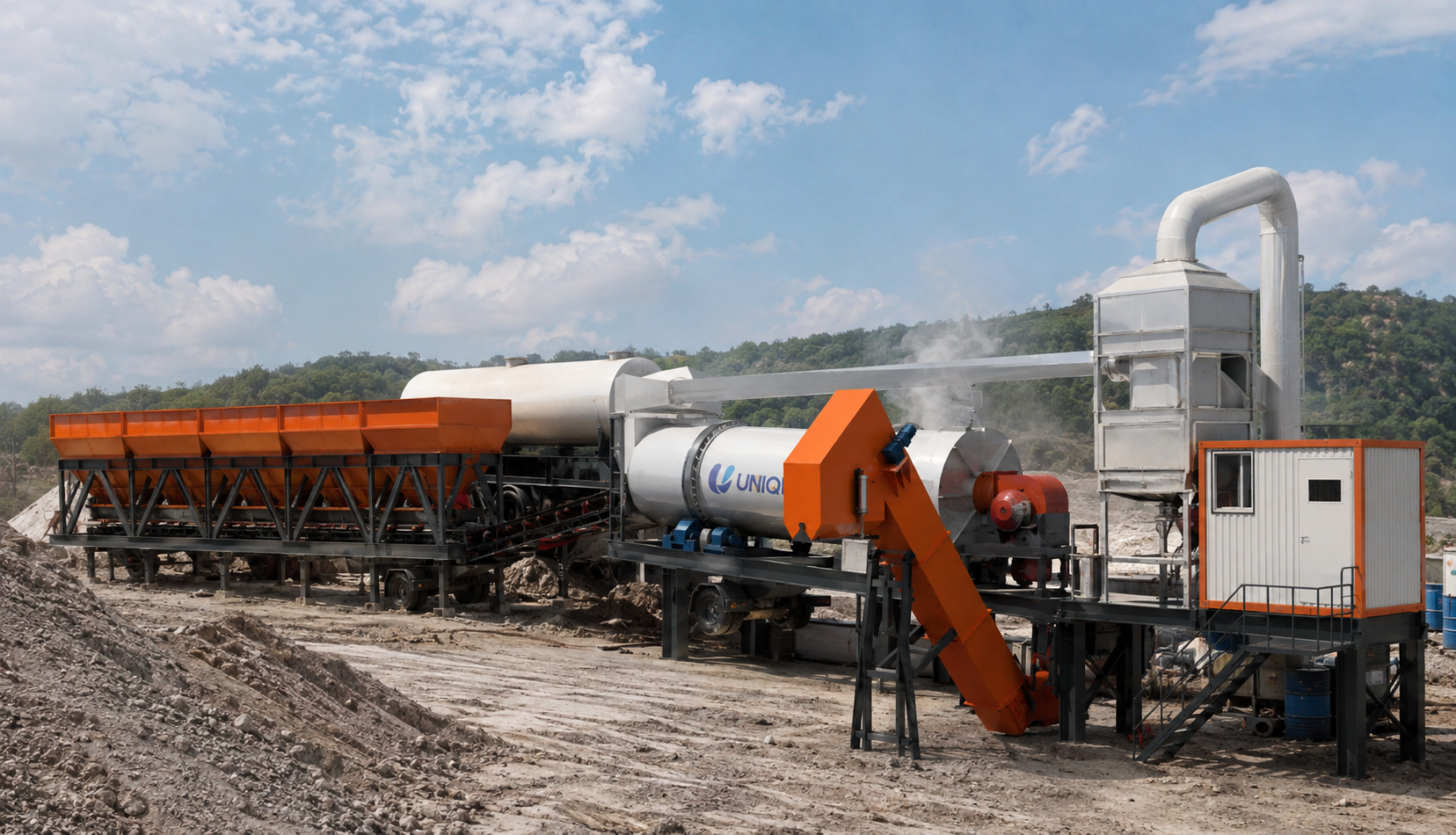
Mobile plants carry their bins and mixer on wheels. They move with the job — ideal for contractors who change sites every few months.
Stationary plants stay put. They work like a permanent mixing facility, designed for high-volume, long-term supply contracts.
Rural Roads & Linear Projects: Follow the Job
County roads and rural highways are small, short and spread out. A contractor may change sites every few months. Here, relocation cost matters more than raw output.
Mobile or transportable asphalt mixing plants go up and come down quickly. One UNIQUEMAC mobile unit can serve several projects in turn, keeping your equipment working year-round instead of sitting idle.
The trade-off? Limited output and storage capacity, and usually a lighter environmental package than a large stationary plant. They suit steady, moderate demand — typically 40–120 t/h — rather than continuous high-volume supply.
Metropolitan Areas: Put Down Roots
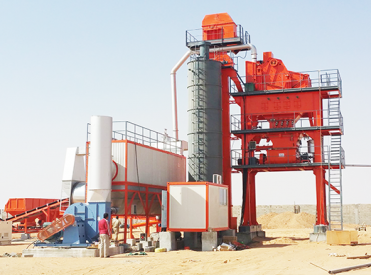
Around big cities, the logic reverses. Stationary plants sit near highway exits or industrial zones so they can serve a wide area with short haul distances. Some are built right at quarries to cut aggregate transport costs.
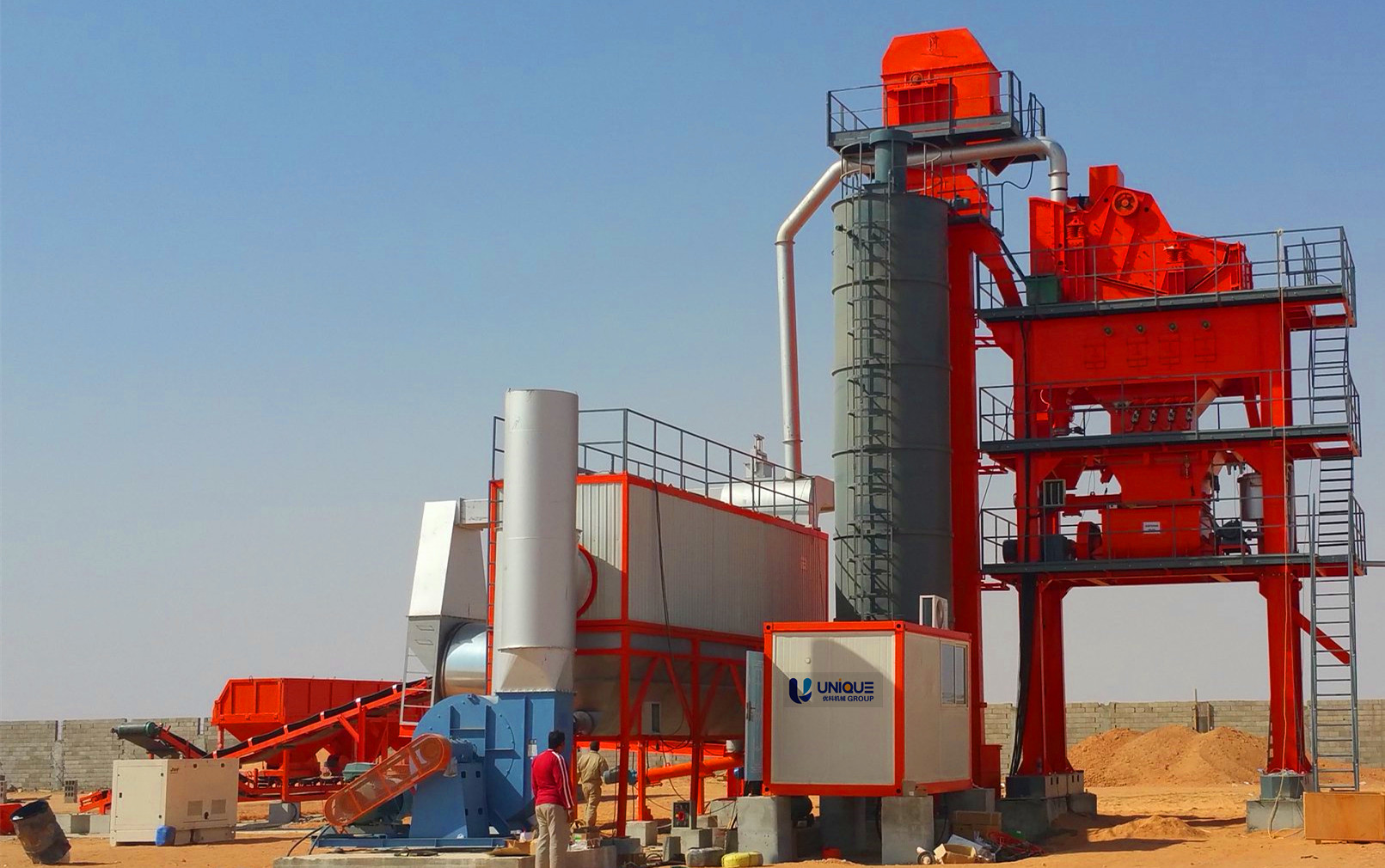
They need a concrete foundation and more upfront investment. But over a multi-year supply contract, the cost per ton and the room for proper dust and emission control usually favor a stationary batch plant — especially models in the 240–400 t/h range.
Bridges & Tunnels: Precision Drives the Choice
Surface courses on bridges and tunnels often use SMA (Stone Mastic Asphalt) or polymer-modified mixes. These are demanding on equipment:
① Mixing temperatures for SMA typically run at 170–185°C, compared to 140–165°C for ordinary mixes.
② The tolerance on binder content is tight — typically within ±0.3% in field checks.
③ Modified binders have minimum transport and storage temperatures, and SMA compaction must happen while the mix is still above 150°C.
④ Once the production mix design is set, it shouldn't be changed casually. If materials change, it must be adjusted promptly.
In hardware terms, this means load cell accuracy, even binder spraying, clean hot-bin separation, stable temperature control and full data traceability. Batch plants are the default here because each batch can be controlled and traced individually. UNIQUEMAC's batch series is built for exactly this kind of precision work.
Power & Fuel Considerations
Before you order, check what's available on site:
① Voltage: 380V/50Hz is standard in many countries, but some regions use 440V/60Hz. UNIQUEMAC plants can be configured to match local power standards.
② Fuel: Diesel burners are the most common, but natural gas burners cut fuel costs by up to 40% over the long term. Some models support both.
③ Remote sites: If there's no grid power, some UNIQUEMAC mobile plants come with an independent diesel generator — no external power needed.
Logistics & Installation
① Container dimensions: UNIQUEMAC's ECO series is designed to fit standard 40ft containers, making ocean freight straightforward.
② Port lifting capacity: Check your destination port's crane capacity before shipping. Most modules weigh 5–15 tonnes each.
③ Installation time: A mobile plant can be operational in 1–3 days. A transportable plant takes 7–15 days. A stationary plant requires 30–60 days including foundation work.
④ Local service: UNIQUEMAC provides installation guidance, operator training and a spare parts list tailored to your region.
A Quick Decision Checklist
1.How long is the project, and will you relocate often?
2.What is the supply radius and daily demand?
3.What surface material is specified, and what does the owner require for batching and temperature records?
4.Can you build a concrete foundation, and what are the local emission rules?
5.What voltage and fuel type are available on site?
Answer these five and the plant type usually picks itself.